simocracy-indexer · dual-tap-epds-firehose
Simocracy Indexer — dual-tap fan-in from certified.one ePDS firehose

Routed the indexer's firehose ingest around bsky.network's 100-account-per-PDS cap by adding a second tap pointed directly at the ePDS, then proved the path end-to-end with a fresh ePDS account.
Headline
Headline. The simocracy-indexer now consumes two atproto firehoses in parallel: relay1.us-east.bsky.network (Bluesky's relay, for accounts on bsky.social and other public PDSes) and https://certified.one (the ePDS, read directly via com.atproto.sync.subscribeRepos). A new account created on certified.one through the email-login flow had its org.simocracy.sim commit observed on the new tap-epds upstream and ingested into DuckDB without going through bsky.network at all. The 100-account cap on bsky.network's per-PDS quota no longer affects ePDS sims.
Why this matters
Bluesky's reference relay (bsky.network) applies a default 100-account-maximum quota to new PDS instances it crawls. The simocracy-indexer's tap consumer was previously connected only to that relay. So as soon as certified.one (the ePDS used by simocracy's email-login flow) crossed account #100, accounts #101+ would be invisible to our indexer — silently breaking the GraphQL/lookup paths the simocracy-v2 webapp relies on.
The com.atproto.sync.subscribeRepos lexicon is identical on every PDS and every relay — a PDS just emits its own accounts' commits instead of the whole network. So we can subscribe directly to wss://certified.one/xrpc/com.atproto.sync.subscribeRepos for a complete view of certified.one accounts, no matter how many of them exist, with zero coordination required (the firehose is public — see the lexicon: "Public and does not require auth; implemented by PDS and Relay.").
Topology change
What changed
Code (simocracy-indexer @ 3074513)
index.js:TAP_WS_URLnow accepts a comma-separated list. Each upstream gets its ownWebSocketwith independent reconnect state. The singlewsmodule-level was replaced with atapConnections[]array of slots./stats: reportstapUpstreams[]andtapConnected[]alongside the legacywsConnected(preserved as any-upstream-connected so existing uptime checks keep working).docker-compose.yml: added atap-epdsservice for local-dev parity, mounted on its own./data-epdsvolume so the two taps don't fight over the same SQLite cursor file.README.md: documented the dual-upstream production topology.
Railway (project simocracy-indexer, env production)
tap-epds (ghcr.io/bluesky-social/indigo/tap:latest) with TAP_RELAY_URL=https://certified.one
Updated varsimocracy-indexer.TAP_WS_URL = ws://tap.railway.internal:2480/channel,ws://tap-epds.railway.internal:2480/channel
Deploy methodrailway add --service tap-epds --image … + railway up --service simocracy-indexer
Smoke test
The smoke test exercises the new path end-to-end: a real new account on certified.one, created via simocracy.org's email-login flow, all the way through to a successful GraphQL lookup against the indexer.
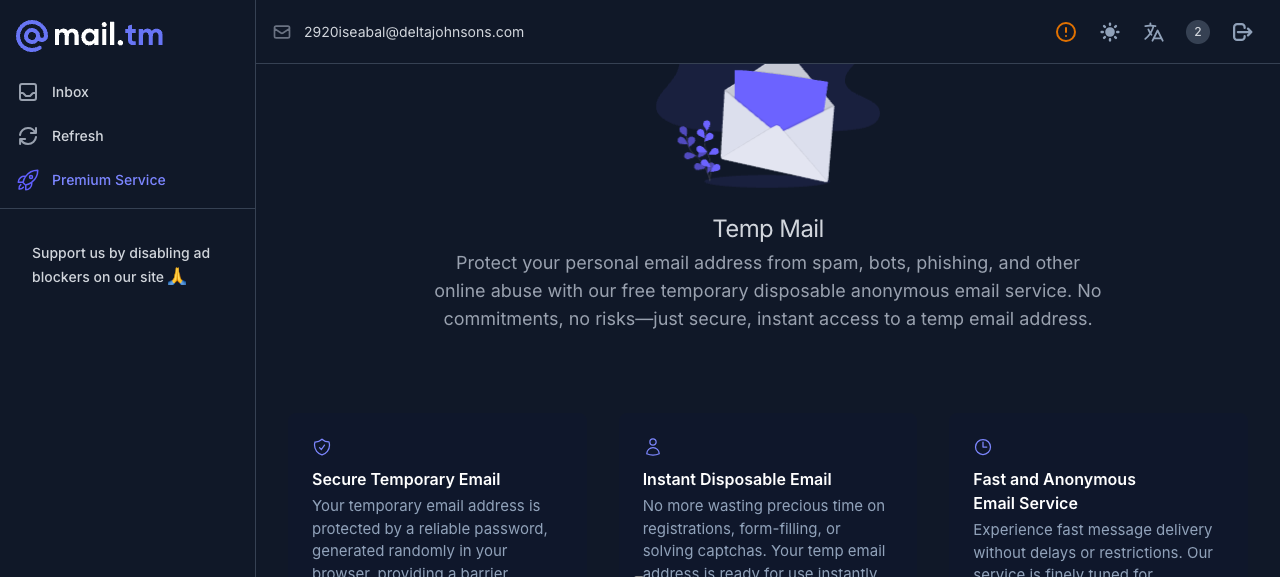
1 — Disposable inbox
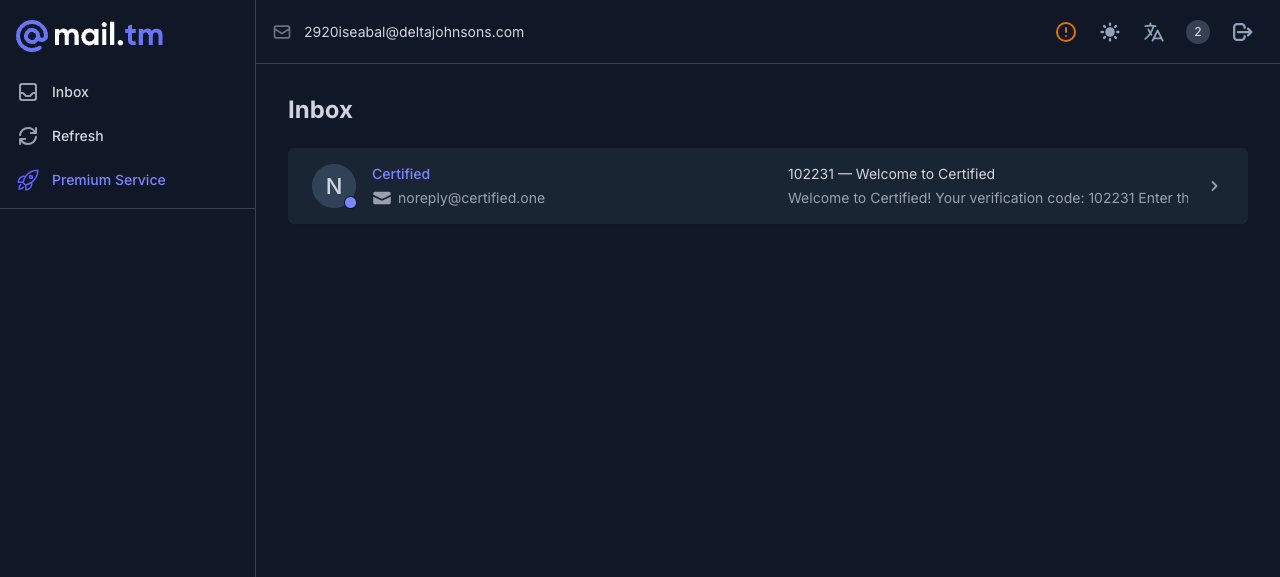
Acquire a temporary email from mail.tm (temp-mail.org refused with a Cloudflare challenge). The inbox came pre-allocated as 2920iseabal@deltajohnsons.com.
2 — Email login on simocracy.org
Open simocracy.org, click Sign In, switch to the EMAIL tab, paste the disposable address. The webapp calls GET /api/oauth/login?email=…, which performs the ATProto OAuth PAR dance and 302-redirects to auth.certified.one with login_hint=<email>.
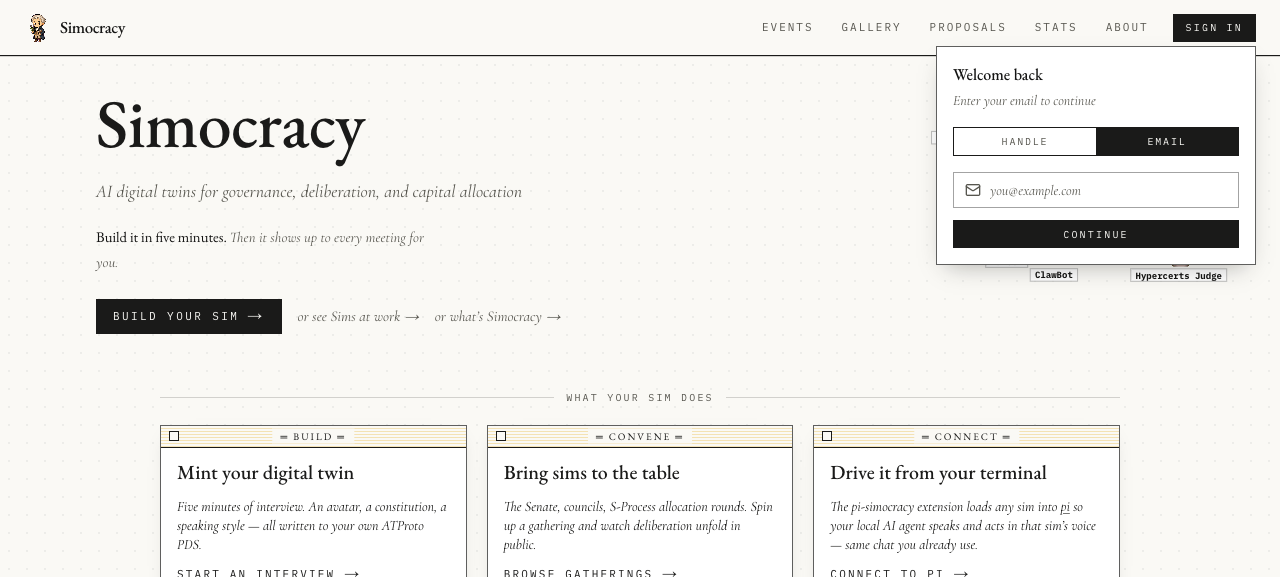
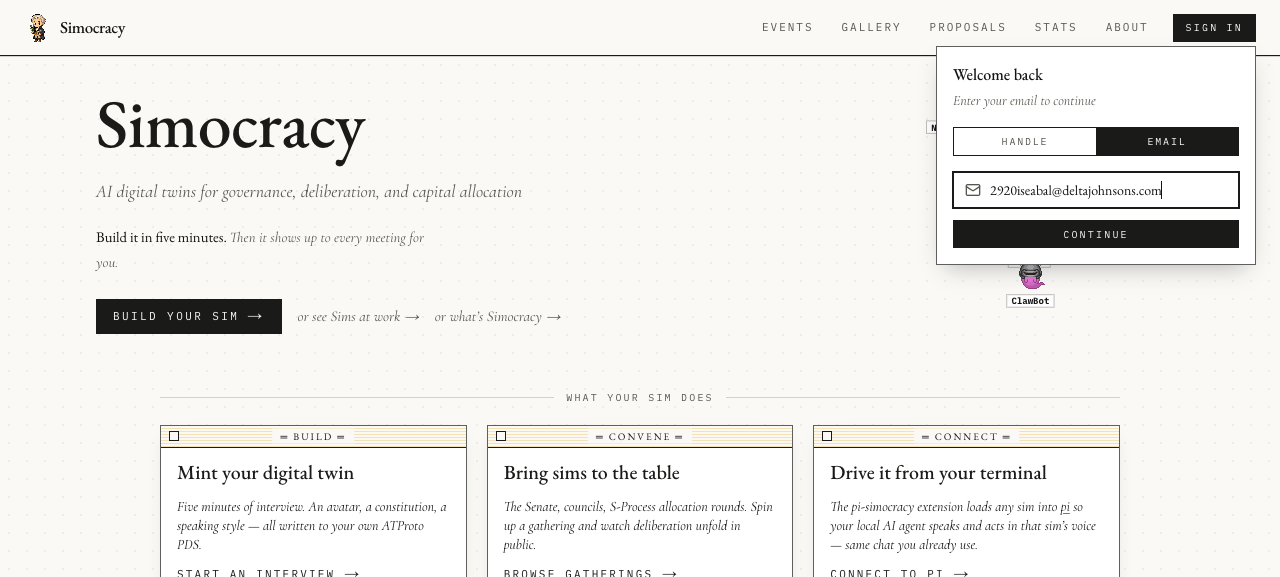
Continue 302s to certified.one.3 — certified.one account creation
certified.one emails a 6-digit code (102231 in this run) to the inbox, which we read back from mail.tm.
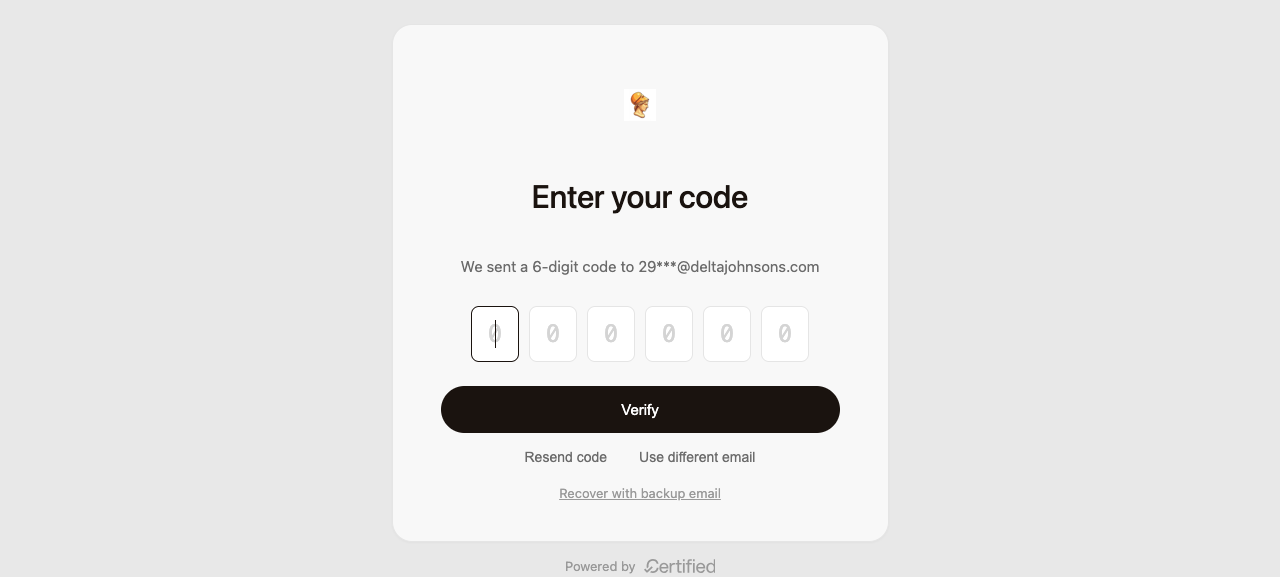
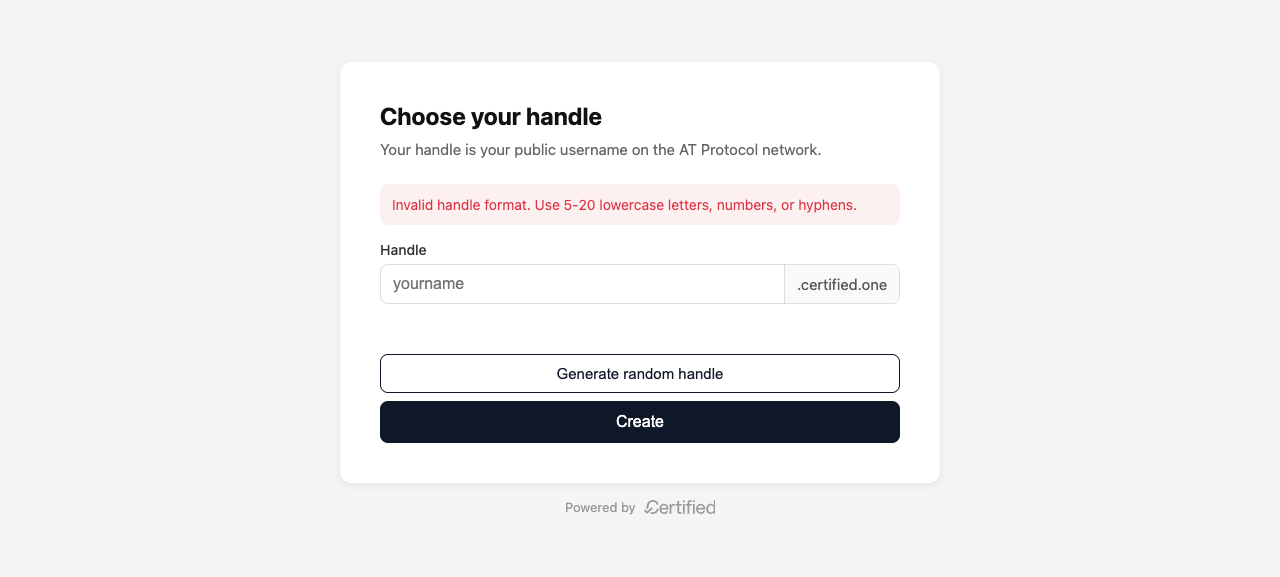
After verification, certified.one prompts for a handle (epds-smoke-test) and renders the OAuth consent screen for the https://www.simocracy.org/client-metadata.json client.
epds-smoke-test.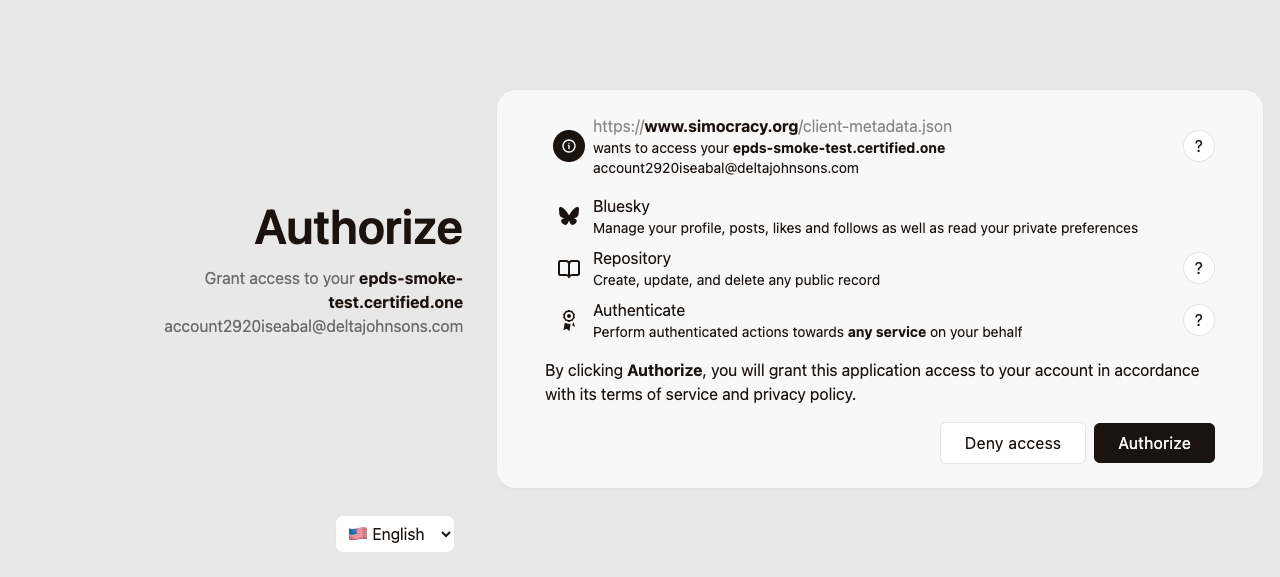
Resolving the new handle confirms the PDS placement is exactly what we need:
$ curl -s "https://public.api.bsky.app/xrpc/com.atproto.identity.resolveHandle?handle=epds-smoke-test.certified.one"
{"did":"did:plc:njw357tdisvgovexfks6xem2"}

$ curl -s https://plc.directory/did:plc:njw357tdisvgovexfks6xem2 | jq '.service[0].serviceEndpoint'
"https://certified.one"
4 — Mint a sim
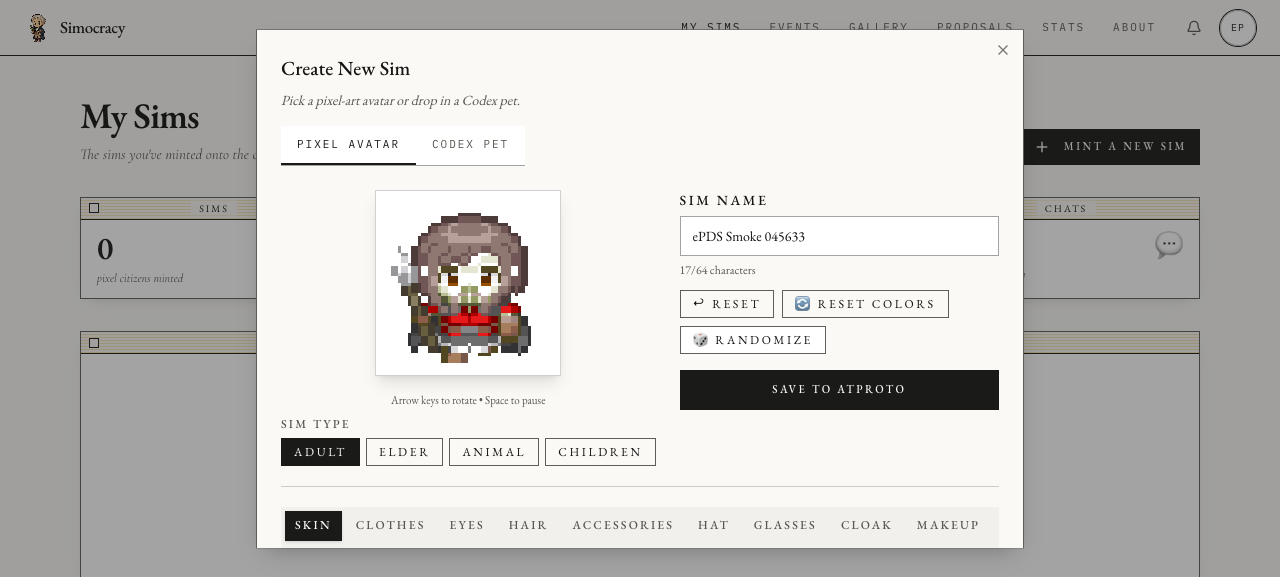
Authorising returns to simocracy.org/my-sims as the new account. Clicking MINT YOUR FIRST SIM opens the avatar editor; we name the sim ePDS Smoke 045633, randomise the appearance, and hit SAVE TO ATPROTO to write a org.simocracy.sim commit to certified.one.
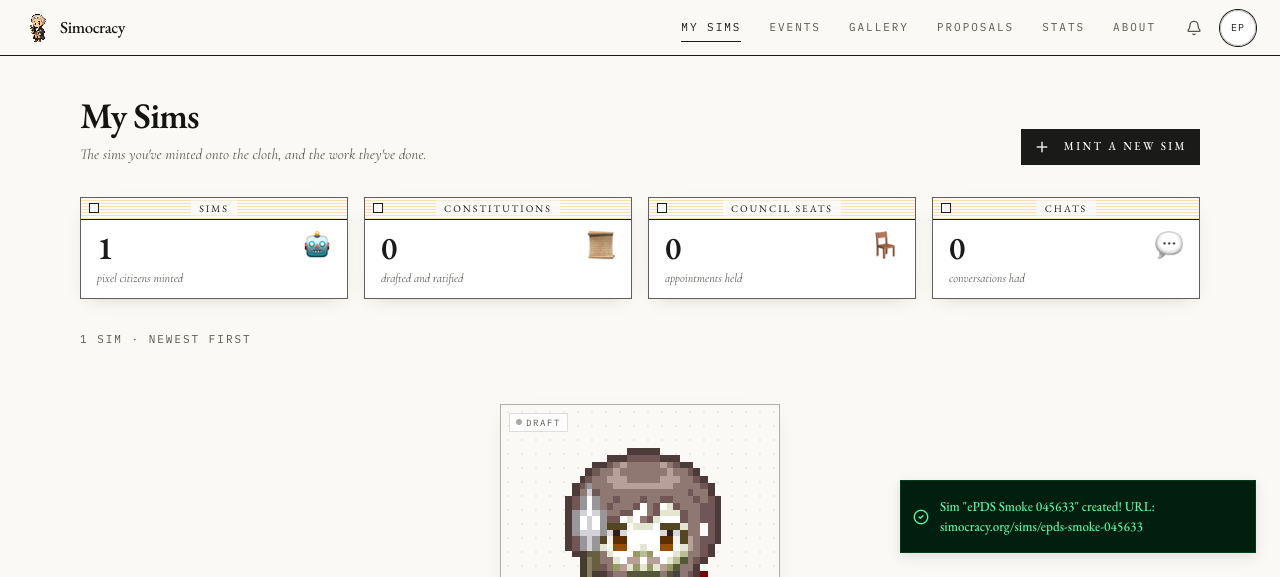
5 — Verify on the PDS
The record lands on certified.one. Listing the repo confirms the AT-URI:
$ curl -s "https://certified.one/xrpc/com.atproto.repo.listRecords?repo=did:plc:njw357tdisvgovexfks6xem2&collection=org.simocracy.sim" | jq '.records[0] | {uri,cid,name:.value.name}'
{
  "uri": "at://did:plc:njw357tdisvgovexfks6xem2/org.simocracy.sim/3ml7oyn62wk2x",
  "cid": "bafyreidxg7l63xhiodrabidfdrf6qu373dez3nntpywyxu7x66i6kkodwu",
  "name": "ePDS Smoke 045633"
}
6 — Verify via the indexer
The indexer's /stats endpoint reports both upstreams as live, and the GraphQL compat layer returns the new record. Both fields are new in this run — tapUpstreams[] and tapConnected[] are the proof that the multi-upstream code path is the one running in production.
$ curl -s https://simocracy-indexer-production.up.railway.app/stats
{
  "recordCount": 957,
  "knownDids": 51,
  "tapUpstreams": [
    "ws://tap.railway.internal:2480/channel",
    "ws://tap-epds.railway.internal:2480/channel"
  ],
  "tapConnected": [true, true],
  "wsConnected": true,
  "inFlightBackfills": 0,
  ...
}

$ curl -s https://simocracy-indexer-production.up.railway.app/graphql \
  -H 'Content-Type: application/json' \
  -d '{"query":"query Q($collection:String!,$first:Int){records(collection:$collection,first:$first){edges{node{uri did rkey value}}}}",
       "variables":{"collection":"org.simocracy.sim","first":1000}}' \
  | jq '.data.records.edges | map(select(.node.did == "did:plc:njw357tdisvgovexfks6xem2"))'
[
  {
    "node": {
      "uri":  "at://did:plc:njw357tdisvgovexfks6xem2/org.simocracy.sim/3ml7oyn62wk2x",
      "did":  "did:plc:njw357tdisvgovexfks6xem2",
      "rkey": "3ml7oyn62wk2x",
      "value": { "name": "ePDS Smoke 045633", "$type": "org.simocracy.sim", ... }
    }
  }
]
The CID and AT-URI match the PDS-side listRecords exactly.
7 — Profile page renders
The simocracy webapp resolves the slug epds-smoke-045633 via its alias map and the indexer feeds the profile route the sim record. The rendered page is end-to-end proof that the user-facing path is healthy:
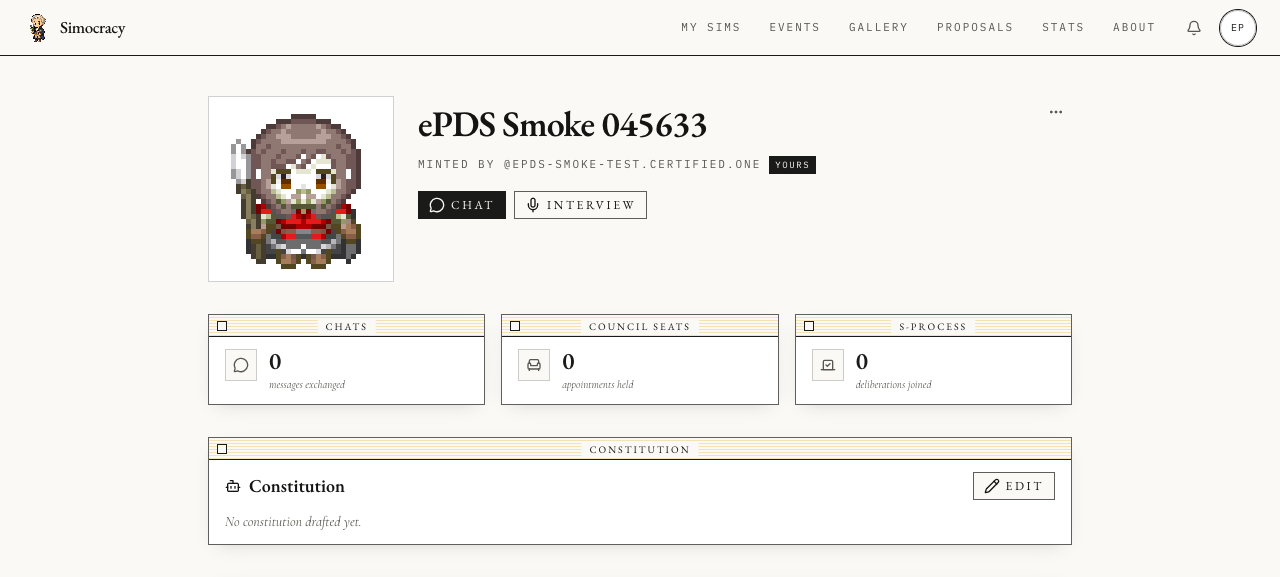
tap-epds.Which upstream actually delivered the record?
Two paths could have produced the record-in-DuckDB outcome: (a) tap-epds's firehose subscription, or (b) the simocracy webapp's post-write ping to GET /backfill-did?did=…. They log differently:
| Source | Code path | Log line format |
|---|---|---|
| Firehose | handleTapMessage() → maybeAutoBackfillNewDid() on first sighting |
First record from new DID <did> — auto-backfilling + Auto-backfill <did>: inserted=N |
| Webapp ping | GET /backfill-did handler in the HTTP server |
Backfill-did <did>: inserted=N |
The production logs from this run show only the firehose log line, which is conclusive:
simocracy-indexer:
  Connected to tap[1] (ws://tap-epds.railway.internal:2480/channel)
  Connected to tap[0] (ws://tap.railway.internal:2480/channel)
  ...
  First record from new DID did:plc:njw357tdisvgovexfks6xem2 — auto-backfilling
  Auto-backfill did:plc:njw357tdisvgovexfks6xem2: inserted=1

tap-epds:
  [INFO] connecting to firehose ... url="wss://certified.one/xrpc/com.atproto.sync.subscribeRepos" cursor=0
  [INFO] connected to firehose
  ...
  [INFO] processing resync did="did:plc:njw357tdisvgovexfks6xem2"
  [INFO] fetching repo from PDS pds="https://certified.one"
  [INFO] resync repo complete
Findings
Pass — dual-tap fan-in works as designed
Both upstreams are healthy, the indexer reports them correctly, and a fresh account on certified.one was indexed via the new tap-epds path within seconds of the sim record being written.
Pass — backwards compatibility preserved
Existing single-upstream deployments don't need to change anything; TAP_WS_URL still accepts a single URL. The legacy wsConnected stat is preserved (now true iff any upstream is open) so existing uptime monitors continue to function.
Warning — tap-epds logs a benign 401 on listReposByCollection
The tap binary tries to enumerate the upstream's accounts via com.atproto.sync.listReposByCollection. certified.one auth-gates that endpoint and returns 401 AuthMissing. This is decoupled from the firehose subscription itself (which is public and works) — it just means tap can't pre-warm its cursor cache from a network enumeration. Functionally harmless; the firehose-driven path catches all live commits.
Info — tap-epds has no Railway volume
Unlike tap (which has tap-volume mounted at /data), tap-epds currently runs without a persistent volume, so a redeploy resets its SQLite cursor to 0. The firehose path itself is fine — tap reconnects from the relay's current head — but a long disconnect after a redeploy could miss commits the relay is no longer sending. Mitigated by the indexer's three other recovery layers (STARTUP_BACKFILL, AUTO_BACKFILL_NEW_DIDS, hourly reconciliation) so this is informational, not a blocker.
Reproducing
did:plc:njw357tdisvgovexfks6xem2
Test recordat://did:plc:njw357tdisvgovexfks6xem2/org.simocracy.sim/3ml7oyn62wk2x
Disposable inboxmail.tm (temp-mail.org Cloudflare-blocks headless)
Driveragent-browser
Screenshotsassets/01-… through assets/16-…