simocracy-v2 · hypercerts-description-union-fix
Hypercerts description & workScope union fix

A three-project audit against the upstream Hypercerts lexicon at hyperscan.dev. Two of the three were silently writing the wrong shape — fixed, regression-tested, all green.
Headline result
Headline. The upstream org.hypercerts.claim.activity lexicon defines description, workScope, and contributorIdentity as unions — each variant is identified by a $type discriminator. flue-simocracy already wrapped its writes correctly; pi-simocracy and simocracy-v2 were emitting bare strings (and one un-discriminated Leaflet doc), which lex-gql silently rejects on the way to the indexer. Patched every write site to wrap correctly, made the simocracy-v2 read pipeline union-aware via a centralised descriptionToText() normaliser, and confirmed all three projects still typecheck, lint, and build green.
The lexicon
The audit's source of truth is the curated lexicon at hyperscan.dev/agents/lexicon/org.hypercerts.claim.activity. Three of its fields are unions, not scalars:
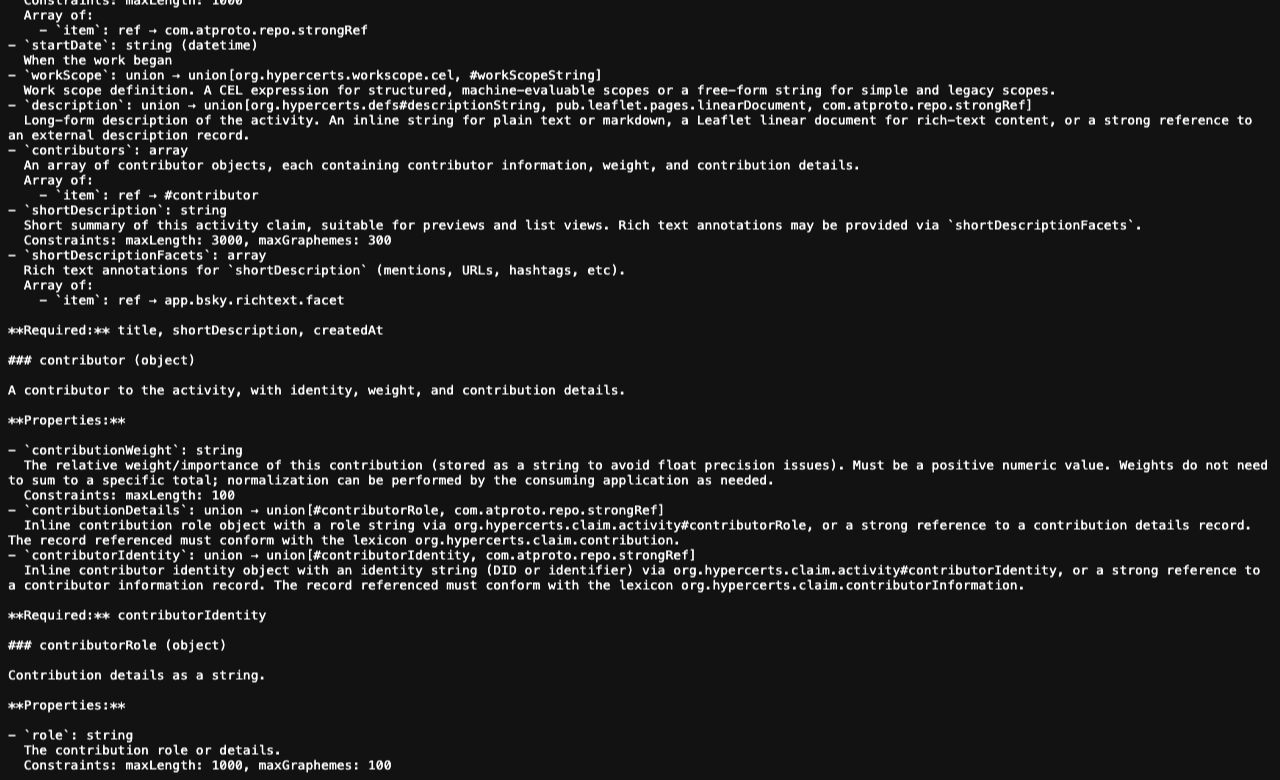
$type discriminator on write.| Field | Union members | Required $type discriminator |
|---|---|---|
description |
descriptionString · leaflet linearDocument · strongRef | org.hypercerts.defs#descriptionString — { value, facets? }pub.leaflet.pages.linearDocument — { blocks } |
workScope |
workScopeString · workscope.cel | org.hypercerts.claim.activity#workScopeString — { scope } |
contributorIdentity |
inline contributorIdentity · strongRef | org.hypercerts.claim.activity#contributorIdentity — { identity } |
Audit — per project
flue-simocracy · already correct
The Telegram-shim agent's post_proposal tool already wrapped all three union fields with the right $type. A code comment beside the writes documents why bare strings are forbidden — evidence the original author already debugged this against the indexer.
// src/tools/post-proposal.ts — unchanged, used as the reference shape
proposalRecord.description = {
  $type: "org.hypercerts.defs#descriptionString",
  value: finalDescription,
};
proposalRecord.workScope = {
  $type: "org.hypercerts.claim.activity#workScopeString",
  scope: workScope.trim(),
};
pi-simocracy · fixed
src/writes.ts · createProposal assigned bare strings to record.description and record.workScope, and forwarded contributor identities as bare strings. lex-gql silently rejects these, so any proposal authored from pi never made it to the indexer (proposals appeared on the user's PDS but were absent from simocracy.org/proposals).
// before — silently dropped on the way to the indexer
record.description = body;
record.workScope   = ws;

// after
record.description = { $type: "org.hypercerts.defs#descriptionString", value: body };
record.workScope   = { $type: "org.hypercerts.claim.activity#workScopeString", scope: ws };
record.contributors = opts.contributors.map((c) => ({
  contributorIdentity: {
    $type: "org.hypercerts.claim.activity#contributorIdentity",
    identity: c.contributorIdentity,
  },
}));
simocracy-v2 · fixed across two write paths + the read pipeline
The webapp has two proposal-form components and they disagreed with each other:
components/ftc-sf/proposal-form-dialog.tsxwrote bare strings (same bug as pi-simocracy) fordescription,workScope, and contributor identities.components/events/gathering-proposal-form.tsxbuilt a Leaflet document fordescriptionbut forgot the top-level$type: "pub.leaflet.pages.linearDocument", so the lex validator couldn't tell which union variant the value was.
On the read side, HypercertActivity.description was typed as string in lib/lexicon-types.ts — a half-truth that worked only because the indexer happened to flatten descriptionString back to a scalar. Anyone calling .slice() on it (e.g. generateMetadata on the proposal permalink page) would crash the moment a real Leaflet doc came through.
Fix:
- Both forms wrap their union writes with
$type(and the Leaflet form now sets the top-level discriminator). HypercertActivity.descriptionis now typed asActivityDescription = string | DescriptionString | LeafletDescription | StrongRef.descriptionToText()inlib/budget-items.tsnow handles all four shapes (string, descriptionString, Leaflet doc, legacy{text}).- Every direct consumer (
.slice, edit-form pre-fill, S-Process LLM payload) was wrapped through the normaliser.
// lib/budget-items.ts — single source of truth, used at every read site
export function descriptionToText(input: unknown): string {
  if (input == null) return ""
  if (typeof input === "string") return input          // indexer-flattened
  if (typeof input === "object") {
    const obj = input as Record<string, unknown>
    if (typeof obj.value === "string") return obj.value           // descriptionString
    if (Array.isArray(obj.blocks)) {                              // leaflet doc
      return obj.blocks
        .map(e => (e as any)?.block?.plaintext)
        .filter((s: unknown): s is string => typeof s === "string")
        .join("\n\n")
    }
    if (typeof obj.text === "string") return obj.text             // legacy
  }
  return ""
}
Where the fixes landed
| Project | File | Change |
|---|---|---|
| flue-simocracy | src/tools/post-proposal.ts | (no change — reference) |
| flue-simocracy | scripts/check-proposal.ts | debug script: union-aware printout for description/workScope |
| pi-simocracy | src/writes.ts | createProposal: wrap description, workScope, every contributorIdentity with $type |
| simocracy-v2 | components/ftc-sf/proposal-form-dialog.tsx | wrap union writes; map contributors to the inline-contributor variant |
| simocracy-v2 | components/events/gathering-proposal-form.tsx | add top-level $type: "pub.leaflet.pages.linearDocument" on textToLeafletDocument() |
| simocracy-v2 | lib/lexicon-types.ts | introduce ActivityDescription union; retype HypercertActivity.description |
| simocracy-v2 | lib/budget-items.ts | extend descriptionToText() to handle the descriptionString variant |
| simocracy-v2 | app/proposals/[did]/[rkey]/page.tsx | normalise via descriptionToText() before .slice(0, 160) in generateMetadata |
| simocracy-v2 | components/ftc-sf/floor-sidebar.tsx | edit-form pre-fill: normalise to text |
| simocracy-v2 | components/ftc-sf/ftc-s-process-modal.tsx | LLM evaluator payload: normalise to text |
| simocracy-v2 | components/events/gathering-world.tsx | edit-form pre-fill: normalise to text |
| simocracy-v2 | components/events/gathering-s-process-modal.tsx | LLM evaluator payload: normalise to text |
Smoke tests
Each project was driven through its full local verification chain. The terminal recording below replays the runs in sequence:
Reproducible from typecheck.tape via vhs assets/typecheck.tape.
| Project | Stack | Verification | Result |
|---|---|---|---|
simocracy-v2 |
Next.js 15 webapp | npx tsc --noEmit · npm run lint · npm run build |
pass — 16 / 16 routes compiled |
pi-simocracy |
Bun-style TS CLI agent | npx tsc --noEmit |
pass |
flue-simocracy |
Flue agent + Telegram shim | npx tsc --noEmit · npm run build (Flue webhook bundle) |
pass — dist/server.mjs emitted |
Findings
What worked — reference implementation
flue-simocracy's post_proposal tool was already correct, including a defensive code comment explaining the silent-drop behaviour of lex-gql when bare strings hit a union field. Used as the canonical shape for the other two.
Fixed — pi-simocracy and simocracy-v2 silently incompatible writes
Both were emitting { description: "...", workScope: "..." } as plain strings. The records land on the user's PDS but never propagate to the Hyperindexer, so they don't appear in simocracy.org/proposals. After the fix, all three projects share one wire shape that matches the lexicon.
Fixed — read-side type gap in simocracy-v2
HypercertActivity.description was typed string, masking the fact that future indexer revisions could surface raw union shapes. Retyped to ActivityDescription and wrapped every direct consumer (.slice, edit-form pre-fill, LLM evaluator payload) through descriptionToText() so the read pipeline now tolerates all four shapes.
Note — indexer-side flattening
The Hyperindexer's GraphQL still returns description as a scalar today (it flattens descriptionString back to a string for backwards compatibility). The post-fix simocracy-v2 read pipeline is forward-compatible with both: scalars pass through unchanged, raw union objects get normalised. No coordinated indexer change required.
Reproducing
cd simocracy-v2 && npx tsc --noEmit && npm run lint && npm run build
Verify pi-simocracycd pi-simocracy && npx tsc --noEmit
Verify flue-simocracycd flue-simocracy && npx tsc --noEmit && npm run build
Re-render terminalvhs assets/typecheck.tape
Lexicon screenshotassets/01-lexicon-claim-activity.png
Smoke recordingtypecheck.webm